Research: Between Hesitation and Hope
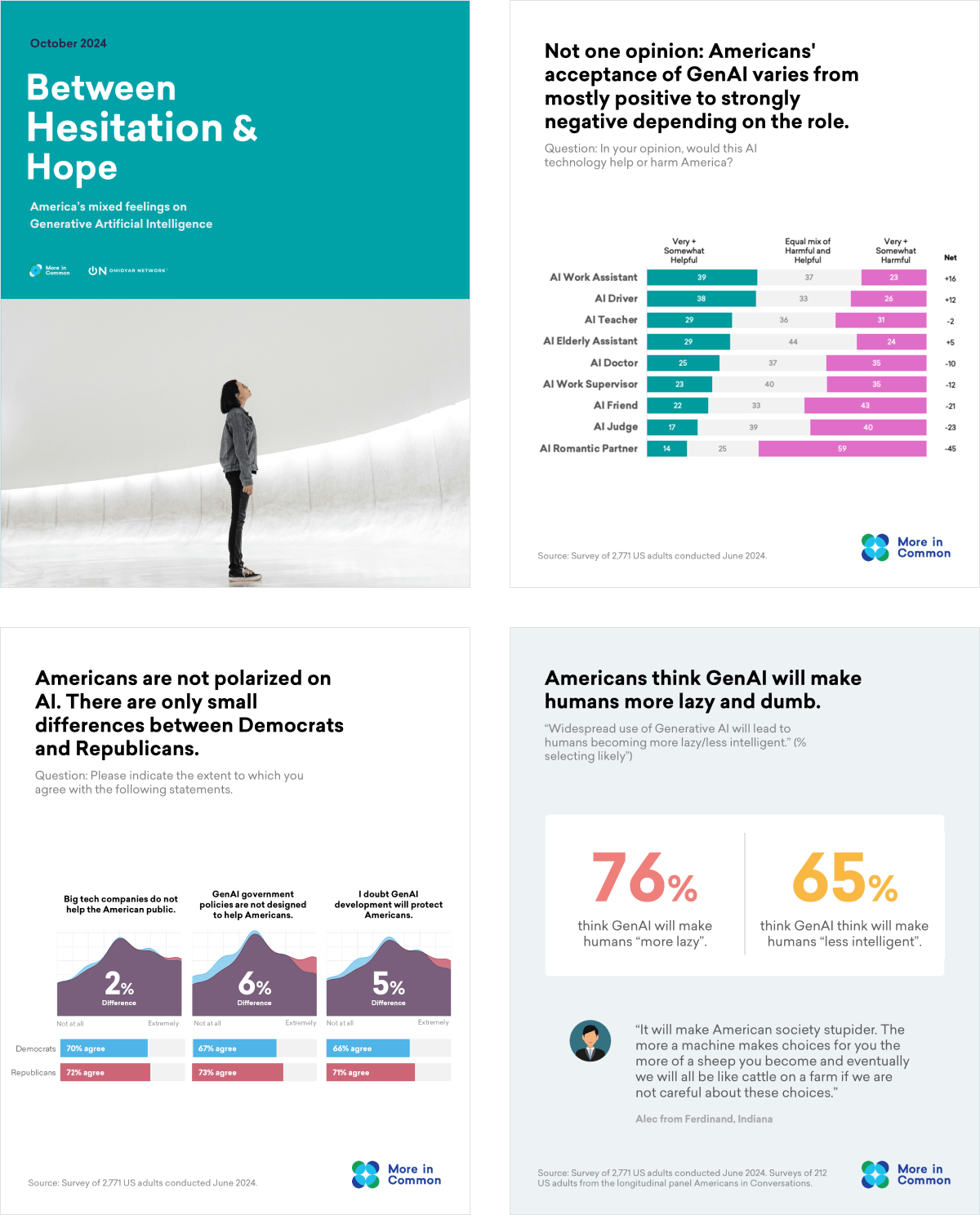
How do Americans actually feel about generative AI? Not the tech-optimist or tech-pessimist framings that dominate public debate, but the genuine, complicated mix of curiosity, worry, and uncertainty that most people carry. This report, released in October 2024 — when generative AI was just beginning to enter public consciousness — was our attempt to answer that question seriously.
I served as research lead on a team effort, overseeing the research design and analysis across a nationally representative survey of 2,771 adults, eight focus groups across four key audiences, a mixed-methods panel, and a segmentation analysis. A few things stood out. GenAI wasn’t yet polarized along partisan lines — Democrats and Republicans were within a few points of each other on nearly every concern. Other groups seemed to predict larger attitude gaps: women, rural Americans, and people with a low sense of belonging were consistently more skeptical. And Americans were skeptical of GenAI’s potential for broad benefit in much the same way they were skeptical of Big Tech and government: a distrust of powerful institutions making consequential decisions on their behalf, regardless of the technology involved.